
From the team
How to teach a 3 year old to read: what the research actually says
Most 3-year-olds aren't ready to decode print, but they are ready for the pre-reading work that makes everything else possible. Here's what the research supports and what to skip.
If you’ve landed here, you’re probably a parent of a 3-year-old wondering whether you should be teaching your child to read. Maybe a friend’s kid is already reading. Maybe you saw a viral video of a toddler reading flashcards. Maybe a well-meaning relative implied your child is “behind.”
Here is the honest version: most 3-year-olds are not developmentally ready to decode printed words, and that is completely normal. What they are ready for is a set of pre-reading skills that build the foundation reading later sits on top of. The work at this age is real, but it doesn’t look like sitting down with a book and sounding out words.
This article walks through what cognitive science says about 3-year-olds and reading, what to actually do, and where parents commonly go off track.
What 3-year-olds actually can do
A typical 3-year-old’s reading brain is preparing the ground. The skills that develop during the toddler and early preschool years aren’t decoding — they’re the underlying language and sound-awareness skills that decoding will eventually plug into.
The three big buckets at this age:
- Phonological awareness (oral only): hearing rhymes, clapping syllables, noticing that “ball” and “bat” start with the same sound. This is purely auditory. No letters required.
- Oral vocabulary: the words your child understands and can use in speech. Vocabulary at age 3 is one of the strongest predictors of reading comprehension at age 10.
- Print awareness: knowing that print carries meaning, that books open a certain way, that English goes left-to-right and top-to-bottom, that those squiggles on the page are what the adult is reading from.
None of these involve sounding out words. All of them are protective for reading later. A 3-year-old who plays rhyming games, hears 5-10 read-alouds a week, and watches a parent point at words while reading is doing exactly the right work.
Letter recognition: yes, but informally
Children typically start recognizing letters somewhere between ages 3 and 5, often beginning with the letters in their own name. This is normal and good. Pointing out the “M” on a McDonald’s sign or noticing that their name starts with the same letter as “Mommy” is meaningful.
What the research does not support is sit-down letter drills with a 3-year-old. Flashcards, “letter of the week” worksheets, and 20-minute phonics lessons at this age don’t accelerate later reading. They mostly just frustrate the child and the parent.
The better version of letter work at age 3:
- Letters in their name, in context (their cubby, their lunchbox, their drawings)
- Alphabet books read aloud, without quizzing
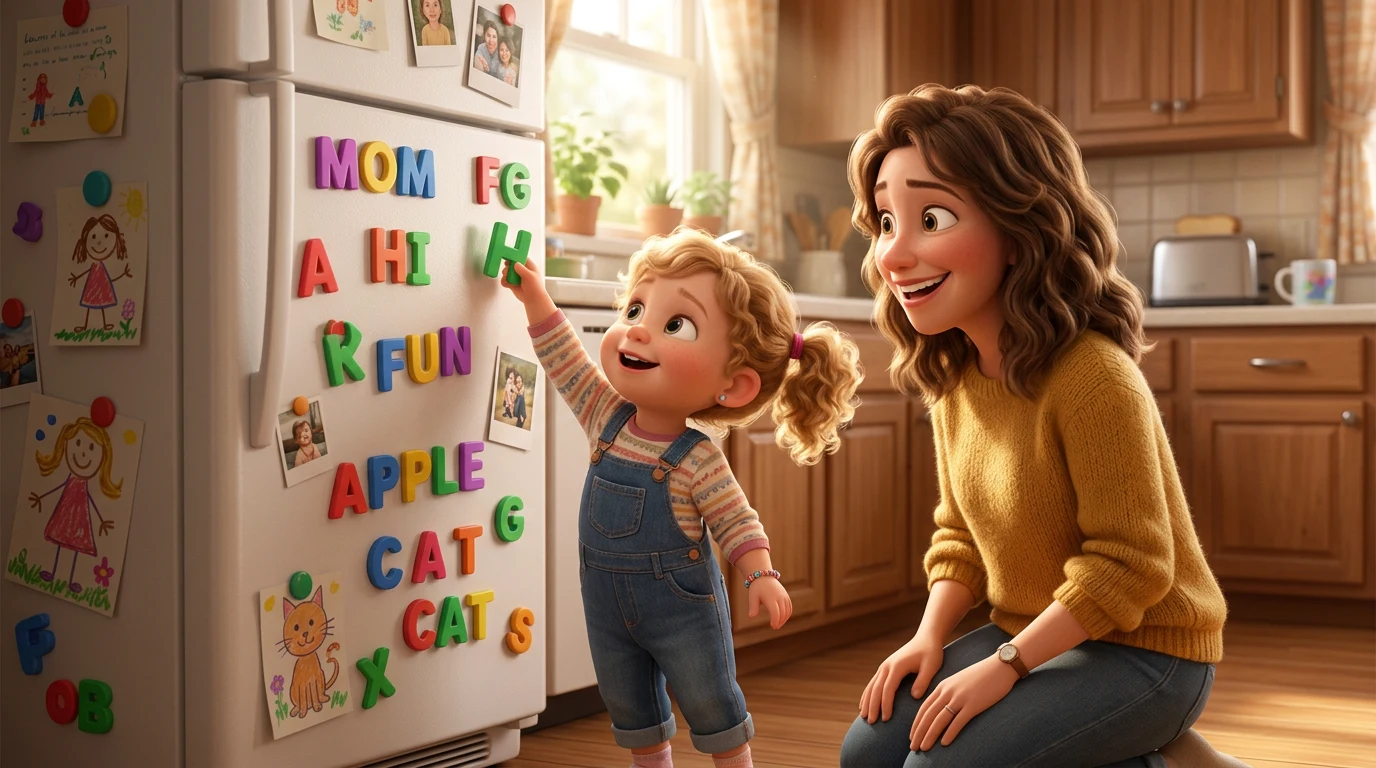
- Magnetic letters on the fridge to play with
- Pointing to print incidentally during read-alouds
If your child wants more — some 3-year-olds genuinely do — follow the lead. If they don’t, don’t push it. Letter knowledge will come during a structured kindergarten phonics program either way.
The “early reader” trap
A small percentage of 3- and 4-year-olds appear to “read” early. Sometimes this is the real thing — a child who has genuinely figured out the sound-symbol code earlier than most. More often, what’s actually happening is one of two things:
- Memorization of whole words by shape. The child has seen the word “STOP” or “PIZZA” or “Mommy” enough times that they recognize the silhouette. This isn’t reading. It’s visual recall. It doesn’t generalize to new words, and it can mask later decoding problems.
- Memorization of familiar texts. After hearing Goodnight Moon 200 times, a child can “read” it aloud while turning pages — but they’re reciting from memory, not decoding. Again, useful exposure, but not the same skill.
This matters because the whole-word-shape approach to early reading was the dominant theory for decades, and it was wrong. Children who memorize whole words by shape hit a wall around 2nd or 3rd grade when the volume of new vocabulary makes memorization impossible. The kids who decode — who can sound out unfamiliar words — keep going.
So if your 3-year-old is “reading” a few familiar words, that’s fine. Don’t build a curriculum around it.
When reading readiness actually emerges
There is no single age when children become ready to read. The honest answer from the research: most children develop reading readiness somewhere between ages 4 and 6, with substantial variation in both directions.
A rough sketch of the typical trajectory:
- Age 3-4: oral phonological awareness developing (rhymes, syllables), letter recognition beginning, vocabulary growing fast
- Age 4-5: phonemic awareness emerging (hearing individual sounds in words), most letter names and some sounds known, may start trying to write their name
- Age 5-6 (kindergarten): explicit phonics instruction begins, blending sounds into words, decoding simple CVC words like “cat” and “sun”
- Age 6-7 (1st grade): most children consolidate decoding, read simple texts independently, build fluency
Some children read before kindergarten. Some don’t fully click until partway through 1st grade. Both ranges are within the normal developmental window. The kindergarten-to-1st-grade gap is where the largest catch-up happens for children who started slower.
The implication for parents of 3-year-olds: trying to compress this timeline rarely works and often backfires. Pushing decoding before phonemic awareness is in place is counterproductive — the child can’t hold the sounds in their head to map them to letters, so the “lesson” is really just compliance training, not reading.
Warning signs worth watching
Most 3-year-olds who seem behind their peers in pre-reading skills will catch up by the end of 1st grade with normal kindergarten instruction. But a small subset have early indicators of a specific learning disability (SLD) like dyslexia, and earlier identification leads to better outcomes.
Things worth noting, especially if there’s a family history of dyslexia or reading difficulty:
- Persistent difficulty with rhyming past age 4 (rhyming is one of the earliest and most reliable indicators)
- Trouble clapping syllables in familiar words
- Difficulty learning the alphabet song or letter names despite repeated exposure
- Speech that remains hard to understand by age 4
- A close family member (parent, sibling, aunt/uncle) with diagnosed dyslexia or a long history of reading struggle
None of these are diagnostic on their own. A 3-year-old who doesn’t rhyme yet is not a dyslexic 3-year-old. But if multiple signs are present, especially with family history, that’s a reason to mention it at the next pediatric visit and ask about early screening. Most state literacy laws (Florida, Mississippi, Ohio, Texas, Colorado, and others) now require universal screening starting in kindergarten, but if there’s family history, you can ask for an earlier conversation.
The other watch-item: a child who was meeting milestones and then regresses, or whose language development stalls. Those warrant a developmental check regardless of reading specifically.
Parent stress vs. research reality
A lot of the parent anxiety around 3-year-old reading is fueled by social media, marketing from early-reading product companies, and stories about exceptional children. Three things worth keeping in mind:
- Early reading does not predict later academic success. Children who read at 3 do not outperform children who read at 6 in later grades, all else equal. The variable that matters is whether the child becomes a fluent reader by the end of 2nd or 3rd grade, not when they started.
- Most children will be reading by the end of 1st grade with developmentally appropriate, structured-literacy kindergarten instruction. The kindergarten year is where the explicit code instruction begins, and that’s the timing the research supports.
- Pre-reading work at home does help — but the form that helps is read-alouds, oral phonological awareness games, vocabulary-rich conversation, and exposure to print. Not flashcard drills.
The parents who win the long game at the 3-year-old stage are usually the ones who read aloud daily, talk to their kids a lot, and resist the pressure to academize toddlerhood.
When to introduce decodable text
Decodable books — texts written so every word can be sounded out using only the phonics patterns the child has been explicitly taught — are the right tool, but for older kids. They’re designed to pair with a structured-literacy phonics scope and sequence, which doesn’t begin until kindergarten in most curricula.
For a 3-year-old, decodable books are usually too advanced (the child can’t decode yet) and too sparse (the texts are deliberately limited to support new readers, not entertain pre-readers). Save them for when phonics instruction has begun, typically kindergarten.
What 3-year-olds want and need from books at this stage:
- Rich, expressive language well above their independent reading level
- Engaging illustrations
- Repetition and predictable structures they can join in on
- Topics they care about (vehicles, animals, family, food, whatever the current obsession is)
Picture books, board books, rhyming books, and concept books are the right register. Children’s literature did not run out of good options for 3-year-olds. Use those.
Where Storytime AI fits
Storytime AI is a structured-literacy practice and assessment platform schools use starting in kindergarten and continuing through elementary school. It generates decodable books matched to the lesson the student is on, measures oral reading fluency, and tracks progress across the six pillars of the Science of Reading.
We mention this for context, not because a 3-year-old should be using it. The platform’s youngest band (K-2) starts at kindergarten, when explicit phonics instruction begins and when decodable text becomes the right developmental fit. If you’re a parent of a 3-year-old, the most useful thing to know is that the structured-literacy world your child will eventually enter does exist, schools are increasingly adopting it, and the kindergarten phonics curriculum is what unlocks reading for most kids.
If you want to read more about what good elementary-level reading instruction looks like, the Science of reading at home post covers the K-5 version of this.
Bottom line
A 3-year-old’s job is to play with language, not decode print. Read aloud to them daily. Play rhyming and syllable games in the car or at bath time. Point at words occasionally while you read. Notice if they want to know letters, and if they do, follow their lead without making it a drill.
Most 3-year-olds will be reading by the end of 1st grade with developmentally appropriate instruction, regardless of whether they could identify five letters at age 3 or none. If you have family history of dyslexia or you see persistent trouble with rhymes and syllables, mention it at your pediatric visit and plan to ask the school about early screening — earlier intervention leads to much better outcomes for the small percentage of kids who need it.
For everyone else: the boring answer is the right one. Read aloud, talk a lot, sing rhymes, and let kindergarten do the explicit decoding work when the timing is right.
Storytime AI
Personalized literacy practice for every reader.
Free to start. Decodable library + on-demand book generation aligned to your curriculum's scope and sequence. ORF assessment, Skill Tree analytics, and adaptive journeys for every student.
About the authors
Written and edited by the Storytime AI founding team.

Brian Carlson
Co-founder & CEO
Co-founder and CEO of Storytime AI. Leads the company from Baltimore, building a literacy platform that meets every reader where they are — anchored to the Science of Reading.
LinkedIn
Scott Quinlan
Co-founder & CTO
Co-founder and CTO of Storytime AI. Owns engineering, product infrastructure, and the agentic growth pipeline — from the platform's AI generation engine to the structured-literacy content surface district leaders evaluate.
LinkedIn
Kate Dwyer
Co-founder & CMO
Co-founder and Chief Marketing Officer at Storytime AI. Translates Science-of-Reading research and product capability into language teachers, parents, and district leaders can act on. Based in the Washington DC–Baltimore area.
LinkedIn