
From the team
Running records vs ORF: why districts are switching
A practical look at what running records and ORF actually measure, why state literacy laws have moved toward ORF, and what teachers gain and lose in the switch.
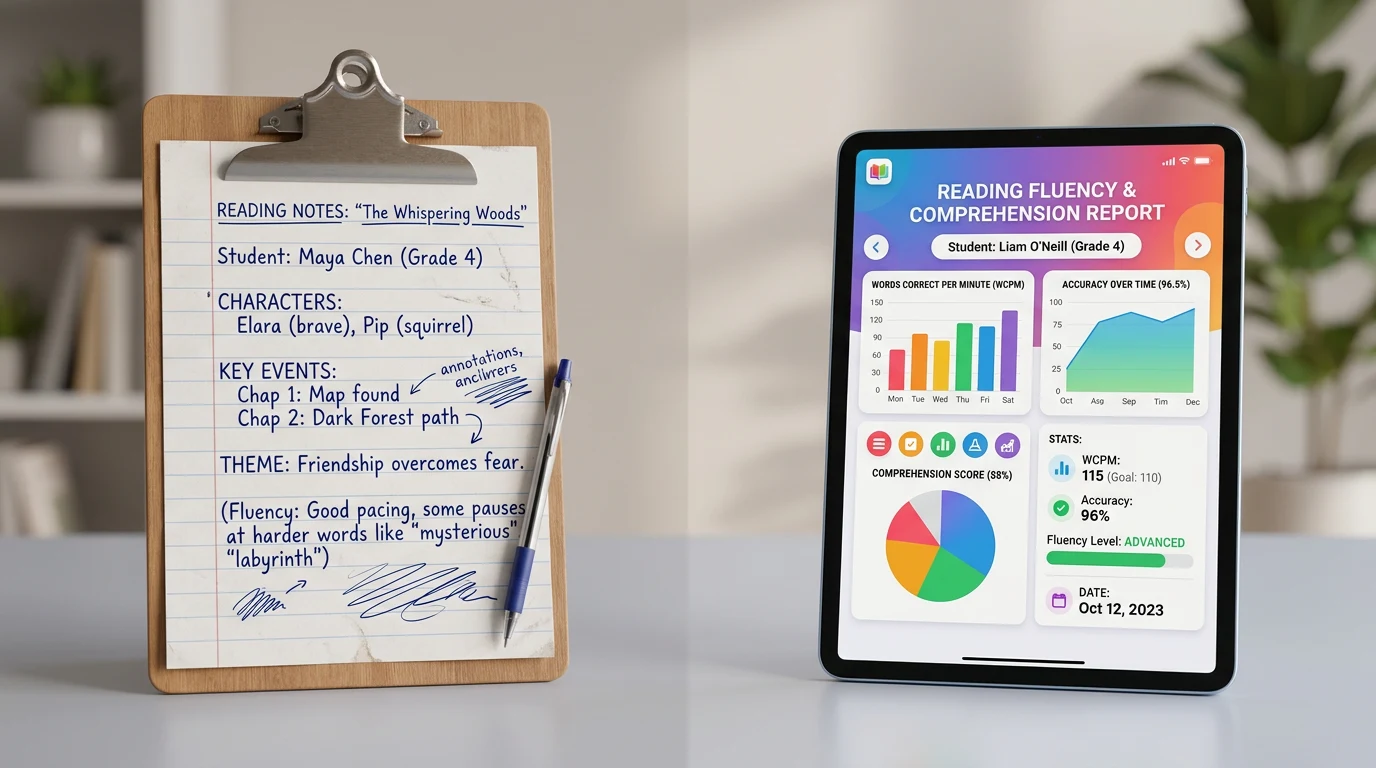
For three decades, running records were the assessment teachers reached for first. Marie Clay’s instrument sat at the heart of Reading Recovery, anchored Fountas & Pinnell Guided Reading, and trained a generation of literacy specialists to listen to a child read and code every miscue in real time. In many buildings the binder of running records was the reading data — the only longitudinal record of what a student could do with a book.
That stack is being dismantled. Districts pivoting toward the Science of Reading have replaced running records with oral reading fluency (ORF) screeners scored on words correct per minute. Several state literacy laws have de-emphasized or prohibited running records as a primary measure of reading skill. The switch is real, and it is not cosmetic — it asks teachers to use a different kind of evidence to make instructional decisions.
This article is a side-by-side: what each assessment actually measures, what the research critique is, what the laws say, and what gets gained and lost in the move.
What a running record measures
A running record is a one-on-one untimed oral reading assessment. The teacher sits beside the student, listens to them read a leveled passage, and codes every word in real time. Substitutions are written above the printed word, omissions are crossed out, insertions get a caret, self-corrections are marked “SC.”
After the reading, the teacher calculates three outputs:
- Accuracy rate — words correct divided by total words, expressed as a percentage. The traditional thresholds: 95%+ is independent level, 90 to 94% is instructional level, below 90% is frustration level. Those percentages drive placement in Guided Reading and Reading Recovery groups.
- Self-correction ratio — how often the student catches and fixes their own errors, relative to how often they err in the first place. A high self-correction rate is read as evidence of self-monitoring.
- MSV miscue breakdown — every substitution is coded for which “cueing system” the student used: M (Meaning), S (Syntax), V (Visual). “Pony” for “horse” is coded M+S (meaning preserved, grammar preserved) but not V (letters don’t match). “House” for “horse” is V (visually similar) but not M or S.
That MSV breakdown is the load-bearing piece. It is not a neutral count of errors — it is an interpretation of why the errors happened, built on Marie Clay’s reading-process theory and Ken Goodman’s “psycholinguistic guessing game” model.
What an ORF assessment measures
ORF is a timed one-minute oral reading on a grade-level passage the student has not seen before. The assessor (or, increasingly, an automated system) counts errors and computes three numbers:
- WCPM (words correct per minute) — words read minus errors, over a one-minute clock. The single headline score.
- Accuracy — percentage of words read correctly, computed the same way as a running record.
- Prosody — phrasing, intonation, and attention to punctuation, rated on a four-point rubric (NAEP or Rasinski).
There is no MSV coding. Errors are errors. A substitution that preserves meaning (“pony” for “horse”) loses an accuracy point and a WCPM point, exactly like any other substitution. The instrument does not try to diagnose which cueing system the student used.
Scoring is normed: Hasbrouck and Tindal’s WCPM tables publish grade-by-grade benchmarks for fall, winter, and spring administrations. A 2nd-grader hitting 89 WCPM in spring is at the 50th percentile against a national sample. That comparability across raters and across years is the practical engine behind ORF’s adoption.
The methodological critique of MSV
The Science of Reading critique is not aimed at running records as a procedure — sitting beside a child and listening to them read is fine. The critique is aimed specifically at the MSV miscue framework that running records are built on.
Three concrete objections show up consistently in the cognitive-science literature:
- Meaning, syntax, and visual decoding are not three coequal pathways. Skilled readers identify words by automatic orthographic recognition — a mapped sound-to-letter system stored in long-term memory. They do not guess from context. Treating M, S, and V as three equivalent cueing systems misrepresents how the reading brain actually works.
- “Meaningful” miscues are word-recognition failures. When a child reads “pony” for “horse” and the assessment celebrates the substitution as evidence of good reader behavior, the assessment is celebrating that the child could not read the printed word. The student needed to decode “horse” and did not. Coding the error as M+S obscures the failure rather than diagnosing it.
- Running records don’t measure orthographic mapping. They are silent on whether a student can decode unfamiliar regularly-spelled words, sound out nonsense words, or store new word forms in memory after a few exposures. The most predictive early-reading skill in the cognitive-science model is the skill the instrument does not probe.
Worth saying clearly: a teacher can sit with a child, listen to them read, and learn useful things without invoking MSV. That observational practice is not the problem. The problem is the framework that turns the observation into a diagnosis built on a contested theory of reading.
What state literacy laws say
State policy has caught up with the research in several jurisdictions. The pattern, broadly:
- Florida — the K-3 literacy framework requires evidence-based screening and de-emphasizes assessment systems built on the three-cueing model.
- Mississippi — the Literacy-Based Promotion Act and subsequent guidance moved districts toward ORF-based screening (DIBELS, Acadience, aimswebPlus) and away from running records as a primary instrument.
- North Carolina — the Excellent Public Schools Act and Read to Achieve guidance explicitly direct districts away from three-cueing-based assessment.
- Tennessee — state literacy guidance favors evidence-based screeners and structured-literacy aligned diagnostic tools.
The specifics vary state to state and the policy details continue to evolve. The shared direction is consistent: state guidance increasingly requires screeners that are normed, comparable across raters, and free of disputed theoretical commitments about cueing systems.
What gets gained in the switch
The practical case for ORF over running records, on the teacher’s side of the desk:
- Speed. A running record on a single student typically takes 15 to 20 minutes. An ORF passage takes one minute of reading plus a minute or two for scoring. Three benchmark windows per year on a class of 25 students is the difference between a week of pull-out assessment and an afternoon.
- Inter-rater reliability. Two trained teachers given the same audio routinely produce different error counts and very different MSV codes — the coding step is judgment-heavy. WCPM is a count. Trained raters land within a word or two of each other.
- Normed comparability. Hasbrouck and Tindal benchmarks make a 2nd-grader’s WCPM legible across classrooms, schools, and years. A running record’s “instructional level” is anchored to a leveling scheme that varies by publisher.
- Faster diagnostic loop. Universal screening three times a year plus progress monitoring every one to two weeks for at-risk students is operationally feasible with ORF and rarely feasible with running records.
- Audio-assisted scoring. Modern ORF platforms transcribe student audio, score WCPM automatically, and rate prosody on a rubric — removing the live-coding cognitive load entirely.
What gets lost in the switch
The honest accounting also has a debit column. Things that were genuinely useful about running records, even setting aside MSV:
- The contextual miscue analysis some teachers valued. Not the MSV interpretation specifically, but the habit of looking at what kind of error a student is making and using that to plan instruction. Skilled teachers learned to extract diagnostic signal from miscue patterns even when they didn’t agree with Clay’s framework. Some of that intuition does not transfer cleanly to a WCPM number.
- The slow, observational stance. Sitting beside a child for 15 minutes while they read connected text is a different kind of teaching evidence than a one-minute timed run. The slower instrument forced a kind of attention that one-minute probes don’t.
- Self-correction as a tracked behavior. Running records produce a self-correction ratio. ORF does not — self-corrections are scoring-neutral. For some teachers that ratio was a useful proxy for monitoring.
Districts moving off running records often replace these losses by other means: teacher observation logs during small-group reading, decodable phrase fluency probes for closer-grain decoding signal, and structured miscue analysis on dictated word lists rather than running passages.
Where comprehension lives now
A subtle but important shift: running records implicitly conflated decoding and comprehension. A student who substituted “pony” for “horse” was scored on a single instrument that mixed word-recognition evidence with meaning-construction evidence. The MSV breakdown made that conflation explicit.
ORF-aligned assessment stacks separate the two on purpose. Decoding shows up on ORF (WCPM, accuracy) and on DIBELS Nonsense Word Fluency for decoding-in-isolation. Comprehension is assessed on a separate normed passage-based instrument. The result is a cleaner diagnostic picture: a child reading at grade-level WCPM with low comprehension is a different intervention case than a child reading slowly with strong comprehension on read-aloud passages.
Decoding and comprehension belong on different rulers. The assessment stack that emerged with ORF reflects that.
Where Storytime AI fits
Storytime AI ORF challenges score oral reading on WCPM, accuracy, and prosody with no MSV miscue analysis. Audio is transcribed, compared to the source text, and scored on the three measures separately — there is no cueing-systems interpretation layered on top. A substitution that preserves meaning loses an accuracy point exactly as it would on DIBELS or Acadience. Word-recognition failure is reported as word-recognition failure.
Comprehension is assessed through separate comprehension quizzes tied to each decodable book, so the decoding-vs-comprehension pattern shows up clearly in the teacher dashboard rather than merged into a single cueing picture. Scoring uses the same Hasbrouck-Tindal WCPM framework that DIBELS and aimswebPlus use, so results are comparable to whatever screener a district already runs.
Bottom line
Running records were a serious instrument for a long time and the teachers who built skill around them are not wrong to feel that something is being lost. What is being lost is the MSV interpretation layer — and the cognitive-science case against that layer is strong. What is being kept is the underlying practice of listening carefully to children read.
ORF is faster, more reliable across raters, normed nationally, and silent on the theoretical claims that drew Science-of-Reading scrutiny in the first place. It is not a perfect instrument either, and districts that simply swap the form without rebuilding the surrounding observation and small-group practice can end up with thinner data than they had before. The switch is worth doing. It is also worth doing carefully.
Storytime AI
Personalized literacy practice for every reader.
Free to start. Decodable library + on-demand book generation aligned to your curriculum's scope and sequence. ORF assessment, Skill Tree analytics, and adaptive journeys for every student.
About the authors
Written and edited by the Storytime AI founding team.

Brian Carlson
Co-founder & CEO
Co-founder and CEO of Storytime AI. Leads the company from Baltimore, building a literacy platform that meets every reader where they are — anchored to the Science of Reading.
LinkedIn
Scott Quinlan
Co-founder & CTO
Co-founder and CTO of Storytime AI. Owns engineering, product infrastructure, and the agentic growth pipeline — from the platform's AI generation engine to the structured-literacy content surface district leaders evaluate.
LinkedIn
Kate Dwyer
Co-founder & CMO
Co-founder and Chief Marketing Officer at Storytime AI. Translates Science-of-Reading research and product capability into language teachers, parents, and district leaders can act on. Based in the Washington DC–Baltimore area.
LinkedIn