
Accuracy
Forced-alignment ASR compares the audio to the printed text. Each word lands in one of three buckets: correct, self-corrected within 3 seconds, or miscued. The accuracy percentage is published the second the student hits stop.
Oral reading fluency
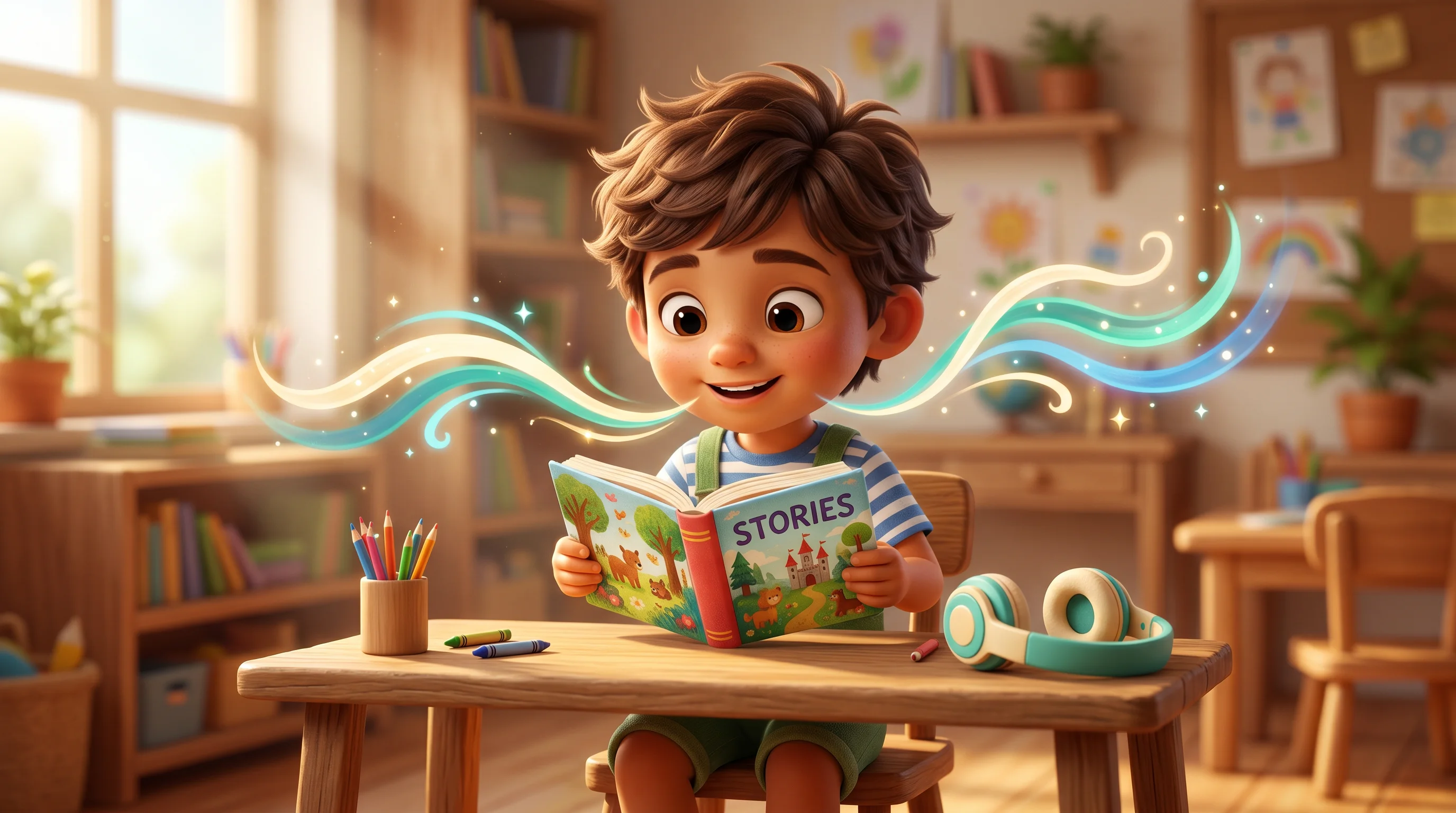
Students record themselves reading. Storytime AI transcribes the audio, scores accuracy, words-correct-per-minute, and prosody, then moves them to the right book — every time. No more once-a-trimester DIBELS probe and a guess.
What gets scored
The same dimensions DIBELS measures — but published the instant a student stops recording, on every reading, not three times a year.
Forced-alignment ASR compares the audio to the printed text. Each word lands in one of three buckets: correct, self-corrected within 3 seconds, or miscued. The accuracy percentage is published the second the student hits stop.
WCPM is computed against grade-level Hasbrouck-Tindal norms. Storytime AI knows the 25th, 50th, 75th, and 90th-percentile thresholds for fall/winter/spring and tags each reading with where the student lands.
A prosody model scores phrasing, expression, smoothness, and pace on the 4-point NAEP scale. Teachers see the rubric score plus a waveform showing exactly where the student paused, accelerated, or flattened.
From score to placement
Storytime AI turns every ORF score into a placement decision automatically. The rule is the instructional zone literacy specialists already use — codified, not invented.
Accuracy below 90%
Place back one decodable level — the text is too hard. Repeat the lesson with explicit re-teach.
Accuracy 90–94%
Stay at the current level — instructional zone. Keep practicing until accuracy and WCPM are both green.
Accuracy ≥95% and WCPM at or above benchmark
Advance one level — the student has earned forward motion. Storytime AI queues up the next book in the journey.
What's in the box
Frequently asked
Oral reading fluency (ORF) is the ability to read connected text accurately, at an appropriate rate, and with expression. It's measured in three dimensions: accuracy (percent of words read correctly), rate (words correct per minute, or WCPM), and prosody (phrasing, intonation, and expression). ORF is one of the strongest predictors of overall reading comprehension because a reader who can't decode fluently spends so much cognitive load on the words that there's no capacity left for meaning.
A DIBELS ORF probe happens once or twice a trimester. Storytime AI scores ORF on every recording — which can be every reading session. The result is a continuous growth curve instead of three data points per year. Teachers see whether a student's WCPM is trending up week-over-week, not waiting until the winter benchmark window to find out a reader has been stuck. The probe format and scoring rubric are equivalent; the cadence is the difference.
Yes. The transcription stack uses a child-voice-tuned ASR model with forced alignment, which is meaningfully more accurate on K-3 audio than off-the-shelf adult-speech models. The system handles common child phenomena like elongated vowels, hesitation, self-correction within a 3-second window, and developmental articulation differences. Teachers can review any recording — audio replays synced to the printed text, so misalignments are visible and correctable in seconds.
Prosody is the music of reading: phrasing, intonation, stress, expression, and pace. Two students can have identical WCPM and very different comprehension — the one who reads with prosody is processing the meaning of the sentence as they go. NAEP's 4-point fluency scale formalizes this: Level 4 reads in larger meaningful phrase groups with appropriate expression; Level 1 reads word-by-word in a monotone. Storytime AI scores prosody automatically so teachers can intervene on expression, not just speed.
Storytime AI uses a three-band rule. If accuracy falls below 90%, the text is too hard — the student moves back a decodable level. From 90–94%, the student stays at the current level (the instructional zone) and gets more practice. If accuracy is 95%+ and WCPM meets or beats the grade-and-season benchmark, the student advances. The placement updates the journey automatically; teachers can override in one click.
Yes. Every recording is replayable in the teacher dashboard. The transcript is highlighted word-by-word as the audio plays — tap any word to hear what the student said at that moment. Miscues are flagged inline. Teachers can correct an automatic score (e.g., the model marked a word wrong but the student's pronunciation is regional) and the override propagates to the student's fluency record.
About the authors

Brian Carlson
Co-founder & CEO
Co-founder and CEO of Storytime AI. Leads the company from Baltimore, building a literacy platform that meets every reader where they are — anchored to the Science of Reading.
LinkedIn
Scott Quinlan
Co-founder & CTO
Co-founder and CTO of Storytime AI. Owns engineering, product infrastructure, and the agentic growth pipeline — from the platform's AI generation engine to the structured-literacy content surface district leaders evaluate.
LinkedIn
Kate Dwyer
Co-founder & CMO
Co-founder and Chief Marketing Officer at Storytime AI. Translates Science-of-Reading research and product capability into language teachers, parents, and district leaders can act on. Based in the Washington DC–Baltimore area.
LinkedInFree classroom, no credit card. A student records one reading; you see accuracy, WCPM, and prosody before the next bell.