
From the team
MTSS implementation for literacy: a playbook
A district playbook for MTSS literacy implementation — universal screening, tier structure, decision rules, team composition, and the pitfalls that quietly derail good frameworks.
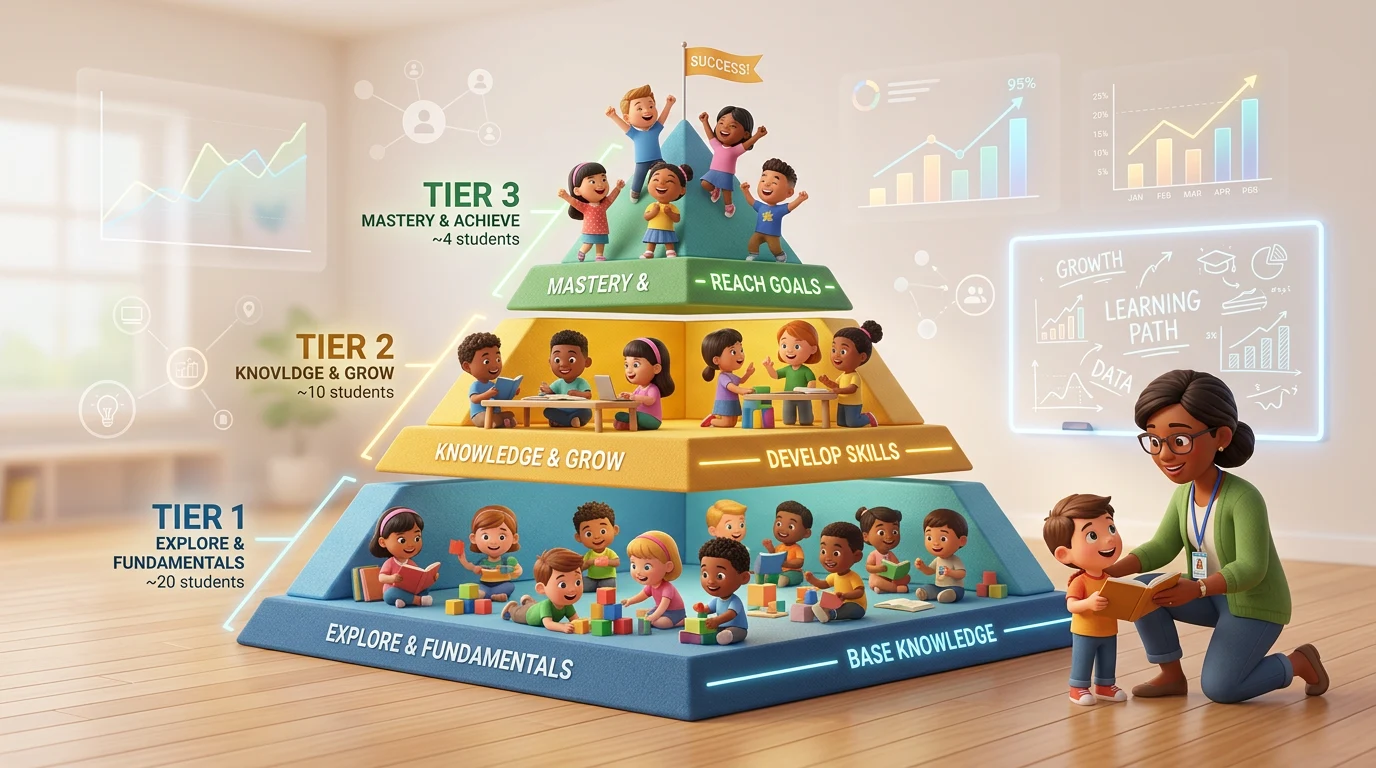
MTSS is the framework most US districts say they use. Read any district literacy plan, browse any state’s accountability dashboard, sit in on any board meeting about reading outcomes — Multi-Tiered System of Supports shows up everywhere. And yet, implementation rigor varies wildly. Some districts run a disciplined, data-driven tiered system that genuinely moves outcomes. Others have an org chart that says “MTSS” and a practice on the ground that looks indistinguishable from what they were doing in 2008.
This playbook is for district leaders, curriculum directors, and principals who are trying to close that gap. It assumes you already know MTSS is the right framework; the question isn’t whether to use it but how to implement it well for literacy specifically.
If you’re newer to the basics, the MTSS glossary entry covers the foundations, including how the framework differs from RTI. If you are mid-transition from RTI and want the operational view — team composition, data systems, state reporting — what actually changes when you switch covers that ground instead.
What MTSS for literacy actually is
MTSS for literacy is the academic side of the broader Multi-Tiered System of Supports framework, which also covers behavior, social-emotional learning, and attendance. The literacy side is where most districts spend the most time, money, and political capital — partly because reading outcomes are measured publicly, partly because the K-3 window for catching reading difficulties is so narrow.
The four operational components are:
- Three tiers of instruction of increasing intensity (Tier 1 universal core, Tier 2 small-group targeted, Tier 3 intensive individualized).
- Universal screening of all students, three times per year, using a brief curriculum-based measure.
- Evidence-based instructional practices at every tier — typically tied to the Science of Reading research base and ESSA evidence tiers when federal funds are involved.
- Data-based decision-making for tier movement, with documented decision rules rather than ad-hoc judgment.
Take any one of these out and the system stops functioning. A district with three tiers but no screening data is guessing at who needs intervention. A district with screening but no decision rules ends up with kids stuck in Tier 2 for years. A district with rules but a weak Tier 1 ends up with half the building in Tier 2 — and the model collapses under its own weight.
Universal screening: the foundation everything else sits on
Universal screening is non-negotiable. Three times per year, every student in the relevant grade band (typically K-5, often K-8) takes a brief, curriculum-based measure designed to flag students at risk of reading difficulty. The most common screeners in US districts are DIBELS (and the newer DIBELS 8th Edition), Acadience Reading, and FastBridge / FAST. The Acadience and DIBELS measures share research lineage and are largely interchangeable in their underlying logic.
What screening is for: identifying which students need closer look. It is not a diagnostic, it is not a placement test, and it is not a label. It is a brief, sensitive measure that tells you who is below benchmark and warrants additional assessment or intervention.
A defensible screening setup has a few characteristics:
- Universal means universal. Every student in the relevant grades, three times per year, no exceptions. Districts that skip “low-risk” students or “above-grade-level” students lose the value of the screen.
- Tight assessment windows. Fall, winter, and spring testing windows should be 2-3 weeks each, so the data isn’t smeared across a quarter.
- Same screener across all schools. Cross-school comparability matters when you’re allocating intervention staff or making board-level decisions. Mixing screeners across schools in the same district almost always creates trouble.
- Trained administrators. Curriculum-based measures only work when they are administered with fidelity. Five minutes of training is not enough; districts that invest in a real screener-administration training session see much cleaner data.
- Same-week data review. Screening data has to be back in teachers’ hands within a week, ideally less. Data that arrives a month later doesn’t drive intervention decisions; it drives compliance reports.
The output of universal screening is roughly three categories: at or above benchmark (Tier 1 only), below benchmark (Tier 2 candidate), well below benchmark (Tier 3 candidate, or comprehensive evaluation referral). Most platforms color-code these as green / yellow / red.
Tier 1: the most-skipped part of MTSS
If MTSS for literacy has a single most-overlooked piece, it is Tier 1. Districts talk about Tier 2 and Tier 3 endlessly because that is where the visible intervention work happens. But Tier 1 is what every student gets every day, in the core literacy block, from the regular classroom teacher. And if Tier 1 is weak, nothing downstream of it works.
The math is straightforward. MTSS assumes Tier 1 is strong enough that roughly 80% of students succeed at grade-level expectations from core instruction alone. The remaining ~15% need Tier 2 and ~5% need Tier 3. Those numbers are how the intervention staffing model gets built — the reading specialist’s caseload, the intervention block on the master schedule, the program licenses.
When Tier 1 is weak, the at-risk percentage climbs. If 40% of your students need Tier 2, you cannot staff Tier 2 at that volume. The intervention groups get too large, the dosage gets cut, the cycle gets diluted, and the system stops working. Every district that has tried to fix bad core instruction by scaling intervention has learned this the expensive way.
A strong Tier 1 literacy block in 2026 has a few characteristics:
- An adopted, evidence-based core curriculum aligned to the Science of Reading. UFLI Foundations, Amplify CKLA, EL Education, IMSE Orton-Gillingham, Wilson Fundations, and similar structured-literacy programs are the common choices. Avoid programs built on three-cueing, balanced literacy, or whole language — they will not produce the Tier 1 success rate MTSS requires.
- A protected literacy block of 90-120 minutes per day in K-3, with explicit phonics instruction baked in rather than treated as an optional supplement.
- Decodable texts matched to the phonics scope and sequence. Students should read text that uses the patterns they have been taught, not predictable leveled readers that train guessing.
- Teacher capacity to deliver the curriculum. That means structured-literacy professional development for every K-5 teacher, not just the reading specialists.
- Fidelity expectations — coaching, walkthroughs, and lesson-internalization routines that ensure the program is actually being taught as designed.
Fix Tier 1 first or Tier 2 will collapse under load. This is the single most important sentence in any MTSS implementation document.
Tier 2: small-group targeted intervention
Tier 2 is supplemental small-group intervention for students whose screening data shows they are not responding adequately to Tier 1 alone. The reading intervention glossary entry covers the defining structural elements at both tiers; the operational view at the district level adds a few considerations.
The structural baseline most districts converge on:
- Group size: 3-5 students with similar skill profiles.
- Session length: 20-30 minutes.
- Frequency: 3-5 sessions per week, in addition to (never instead of) the Tier 1 literacy block.
- Cycle length: 8-12 weeks before a formal team review.
- Progress monitoring: weekly or bi-weekly curriculum-based measure graphed against an expected growth slope.
At the district level, the questions to answer are who delivers Tier 2, what programs are used, and how time gets protected on the master schedule.
Who delivers Tier 2: usually a mix of classroom teachers (during protected intervention blocks), reading specialists, Title I interventionists, and trained instructional aides working under a credentialed teacher’s plan. No special-education credential is required — Tier 2 is still general education. What is required is training on the specific intervention program.
What programs to use: the highest-fidelity districts pick one or two evidence-based programs and train staff deeply on those, rather than letting every interventionist assemble materials. Common Tier 2 program choices include UFLI Foundations in a small-group configuration, Wilson Just Words and Step-by-Step, SIPPS (Systematic Instruction in Phonological Awareness, Phonics, and Sight Words), REWARDS for older students working on multisyllabic decoding, and Heggerty’s intervention curriculum for phonemic-awareness gaps. ESSA evidence tier matters when federal funds are involved.
How to protect time: the master schedule has to carve out a “what I need” block (sometimes called WIN, intervention, or enrichment time) when classroom teachers are not delivering new Tier 1 content. Without protected time, Tier 2 gets cancelled for assemblies, coverage, and weather days — and it stops being intervention.
Tier 3: intensive individualized intervention
Tier 3 is for students who have not responded adequately to Tier 2 after one or two 8-12 week cycles, or for students whose initial screening data was so far below benchmark that Tier 2 isn’t intensive enough to catch them up. The Tier 2 vs Tier 3 comparison sets out what changes between the two; at the district level, the operational distinctions are intensity, group size, and team composition.
The structural baseline:
- Group size: 1-3 students, often 1-on-1 for the most intensive cases.
- Session length: 30-60 minutes.
- Frequency: daily, 5 sessions per week.
- Cycle length: 8-12 weeks before formal review.
- Progress monitoring: 1-2 times per week, graphed against a more aggressive growth slope.
- Delivered by: reading specialist, special education teacher (if the student is already qualified), or highly-trained interventionist.
Tier 3 is where the line between general education intervention and special education evaluation can get blurry. Some districts treat Tier 3 as still general education until a comprehensive evaluation is initiated. Others treat Tier 3 as the trigger to begin evaluation. The right approach depends on state law and district policy, but the principle is the same: Tier 3 is not a holding pattern. Either the intensive intervention is working and the student is closing the gap, or the data is showing that this student needs a different kind of support and an evaluation should be initiated.
Programs commonly used at Tier 3 include the most-intensive small-group versions of Wilson Reading System, Lindamood-Bell LiPS or Seeing Stars, Sonday System, and Take Flight (for diagnosed dyslexia). Tier 3 programs are typically more diagnostic, more deeply scripted, and more multisensory.
Progress monitoring cadence
Progress monitoring is the daily fuel of an MTSS system. Without it, you cannot tell whether intervention is working, you cannot make tier-movement decisions, and you cannot defend your placement decisions to parents.
A defensible cadence by tier:
- Tier 1 students: universal screening 3x/year only. No additional probing.
- Tier 2 students: weekly or bi-weekly curriculum-based measure on the targeted skill (most commonly an oral reading fluency probe for grades 2+, nonsense word fluency or phoneme segmentation fluency for K-1).
- Tier 3 students: 1-2 times per week, often with additional diagnostic probes.
The measure has to actually match what is being taught. If a student is in Tier 2 for phonemic awareness, the progress probe should be a phonemic-awareness measure, not an oral reading fluency measure that is downstream of the skill gap. This is one of the most common Tier 2 failure modes — using a generic fluency probe to monitor a phonics or PA intervention, then being surprised when the probe doesn’t reflect the intervention’s actual targets.
The data has to be graphed and reviewed. A folder of probe scores nobody looks at is not progress monitoring. A clean line graph with the student’s data points plotted against an expected slope is.
MTSS team composition
The MTSS team — sometimes called the Student Support Team, Intervention Team, or PSP Team depending on the district — is the body that makes tier-movement decisions, reviews progress-monitoring data, and oversees the intervention system at the building level. A defensible team has a few standard roles:
- Principal or assistant principal as the convener and decision authority.
- Reading specialist or literacy coach as the literacy content expert.
- Classroom teacher of the student being discussed (rotating by case).
- Interventionist providing the Tier 2 or Tier 3 instruction (rotating by case).
- School psychologist when the conversation is approaching a special-education evaluation referral.
- Counselor or behavior specialist when the case has behavioral components.
- Parent as a participant, particularly at tier-movement decision points.
The team meets on a regular cadence — typically every 4-6 weeks, sometimes more frequently — and works from a documented agenda that includes the screening data, the progress-monitoring graphs, and the decision rules. Meetings without data are problem-solving sessions; meetings with data are MTSS team meetings.
Common pitfalls that quietly derail MTSS
Even districts that have invested heavily in MTSS fall into the same handful of failure patterns. Knowing them in advance is half the battle.
“MTSS at our district is just RTI without behavior.” MTSS extended RTI to include behavioral, social-emotional, and attendance support — but many districts have rebranded their academic RTI program as MTSS without actually integrating the behavioral side. That is not necessarily fatal for literacy outcomes specifically, but it does mean the district isn’t getting the full benefit of an integrated system. Worth being honest about internally even if external branding stays as MTSS.
Missing or unused screening data. The screen-but-don’t-act pattern is common. Universal screening data lands in a dashboard somewhere, but the at-risk students don’t actually get into intervention groups within the first few weeks of a cycle. By the time intervention starts, you’ve lost a third of the cycle. The remedy is a documented post-screening workflow: screening closes → at-risk roster is generated → intervention groups are formed → groups start → first progress probe is collected. All inside two weeks.
Tier 2 with the wrong programs. Tier 2 fails when the programs being used are not evidence-based, are not aligned to the skill gap, or are not implemented with fidelity. A particularly common version: pulling kids out of class for “more reading practice” without any structured-literacy intervention program. That isn’t Tier 2; it’s a study group.
No progression criteria between tiers. Without documented decision rules, the system runs on the judgment of individual team members, and the same student can stay at the same tier for years. Decision rules don’t have to be elaborate — even simple thresholds like “no growth on weekly probes for 6 consecutive weeks triggers tier movement consideration” are far better than nothing.
Schedule drift. Intervention time gets cancelled for assemblies, picture day, coverage, weather closings, testing. By the end of the cycle, the student who was supposed to receive 15 sessions has received 9. Districts that take intervention seriously protect the time on the master schedule and track session counts as a fidelity measure.
Ignoring Tier 1 forever. When the at-risk percentage in a building stays above 35-40%, the right response is to revisit Tier 1 — the core curriculum, the scope and sequence, the fidelity of implementation, the professional development calendar. The wrong response, and the more common one, is to keep adding Tier 2 staffing.
Where Storytime AI fits
Storytime AI is built to function across all three tiers as a practice, assessment, and progress-monitoring layer that sits alongside whichever core curriculum your district has adopted.
For Tier 1, Journey Builder lets teachers compose the daily practice path students follow, aligned to the literacy program your school is teaching (UFLI, Amplify CKLA, Wilson, IMSE, LMW, or Storytime AI’s own structured-literacy progression). For Tier 2, teachers can build targeted small-group journeys focused on the specific phonics pattern, fluency threshold, or phonemic-awareness skill the screener surfaced, drawing on the decodable book library and on-demand generation. For Tier 3, per-student paths support intensive ORF challenges, decodable repetition for orthographic mapping, and Hi-Lo decodables for older intervention students.
The Skill Tree analytics view gives the MTSS team a classroom-level distribution across the six Science of Reading pillars, so the at-risk cluster on a specific strand shows up without manual roster review. ORF scoring provides the weekly fluency data many districts already use as a Tier 2 progress-monitoring measure, without requiring a separate screener subscription. And the on-demand small-group infrastructure means intervention teachers can pull a targeted decodable and quiz set in seconds, rather than assembling materials from photocopied workbooks.
Storytime AI does not replace your screener, your core curriculum, or your intervention program. It is the connective tissue between them — the practice and analytics layer that makes the tiered structure run.
The one-paragraph version
MTSS for literacy works when universal screening is real and three times a year, Tier 1 is strong enough that 80% of students succeed without intervention, Tier 2 is small-group (3-5 students, 20-30 minutes, 3-5 days a week, 8-12 week cycles, weekly monitoring), Tier 3 is intensive (1-3 students, 30-60 minutes, daily, weekly to bi-weekly monitoring), and the MTSS team meets on a regular cadence with documented decision rules that actually drive placement. It fails — predictably and expensively — when any of those pieces is missing. Start with Tier 1. Pick one or two intervention programs and train staff deeply. Protect intervention time. Write the decision rules. Use the data. That is the playbook.
Storytime AI
Personalized literacy practice for every reader.
Free to start. Decodable library + on-demand book generation aligned to your curriculum's scope and sequence. ORF assessment, Skill Tree analytics, and adaptive journeys for every student.
About the authors
Written and edited by the Storytime AI founding team.

Brian Carlson
Co-founder & CEO
Co-founder and CEO of Storytime AI. Leads the company from Baltimore, building a literacy platform that meets every reader where they are — anchored to the Science of Reading.
LinkedIn
Scott Quinlan
Co-founder & CTO
Co-founder and CTO of Storytime AI. Owns engineering, product infrastructure, and the agentic growth pipeline — from the platform's AI generation engine to the structured-literacy content surface district leaders evaluate.
LinkedIn
Kate Dwyer
Co-founder & CMO
Co-founder and Chief Marketing Officer at Storytime AI. Translates Science-of-Reading research and product capability into language teachers, parents, and district leaders can act on. Based in the Washington DC–Baltimore area.
LinkedIn